Canon EOS 850D Rebel T8i review
Unofficial
 The Canon EOS 850D / Rebel T8i is a well-featured mid-pasture DSLR that sits at the top of the triple-finger Eos or Rebel series. It delivers a comfortable step-up in features and handling over the cheaper entry-degree models, making it a unspoiled choice for anyone who wants a decent DSLR without breaking into four figures. As e'er though, Canon offers a wide range of models at different price points, to each one oblation a tempting stepping-stone to the next level. The EOS 90D is arguably its biggest rival, and while the boost in resolving power make up undersize difference in real-life, it's the wealth of smaller upgrades that come through worth investment in the higher price. In the meantime the mirrorless M6 II may lack a viewfinder as authoritative but gives you a batch of the 90D at the same body price as the 850D / T8i. Thither's also the older M50 sporting a viewfinder, in full-articulated screen and the same photo and picture character of the 850D in a smaller body at a lower price - and with a wider kit surg too. Ultimately the Eos 850D / Renegade T8i is a fine DSLR and one that performs well for the money - and if you're after a Canon DSLR at this price luff, I can urge it. Simply again if you're sounding for a longer-term investment to grow with, you'll find the 90D more powerful overall, so if you can stretch out to it, I'd strongly recommend taking the leap.
Pip out now!
Check prices connected the Canyon EOS 850D / Rebel T8i at B&H, Amazon, Adorama or WEX! Alternatively get yourself a copy of my In Tv camera book or care for me to a coffee! Thanks!
Canon Eos 850D Rebel T8i review -
- Written by
Intro
The Canon EOS 850D, Beaver State Insurrectionist T8i as it's known in In the north America, is a middle-range DSLR with a 24 Megapixel APSC detector, 7fps bursts, cropped 4k TV and a to the full-articulated touchscreen. It sits at the top of the triple-digit EOS or Arise series, which puts it directly below the EOS 90D. Announced in February 2020, it got a little lost amongst the initial EOS R5 teasers, then didn't actually arrive to the shops until the following Autumn, but it's here forthwith so in this review I'll show you what it can execute, crucially when compared to the higher-end Eos 90D. So does the 850D or T8i accomplish a confection-spot of price-performance, is it deserving spending the extra on the 90D, or does a mirrorless camera now make more sense for you? Let's uncovering out!
My full review with try out images, movies and head-to-head comparisons is in the video on a lower floor, simply if you prefer a written version, keep scrolling!
Note: it drives everyone mad to celebrate repeating the multiple names of these more affordable Canon DSLRs, so from this point on, I'll just atomic number 4 calling IT the Eos 850D, but remember everything I sound out and bear witness you, equally applies to the Rebel T8i equally it's exactly the identical camera.
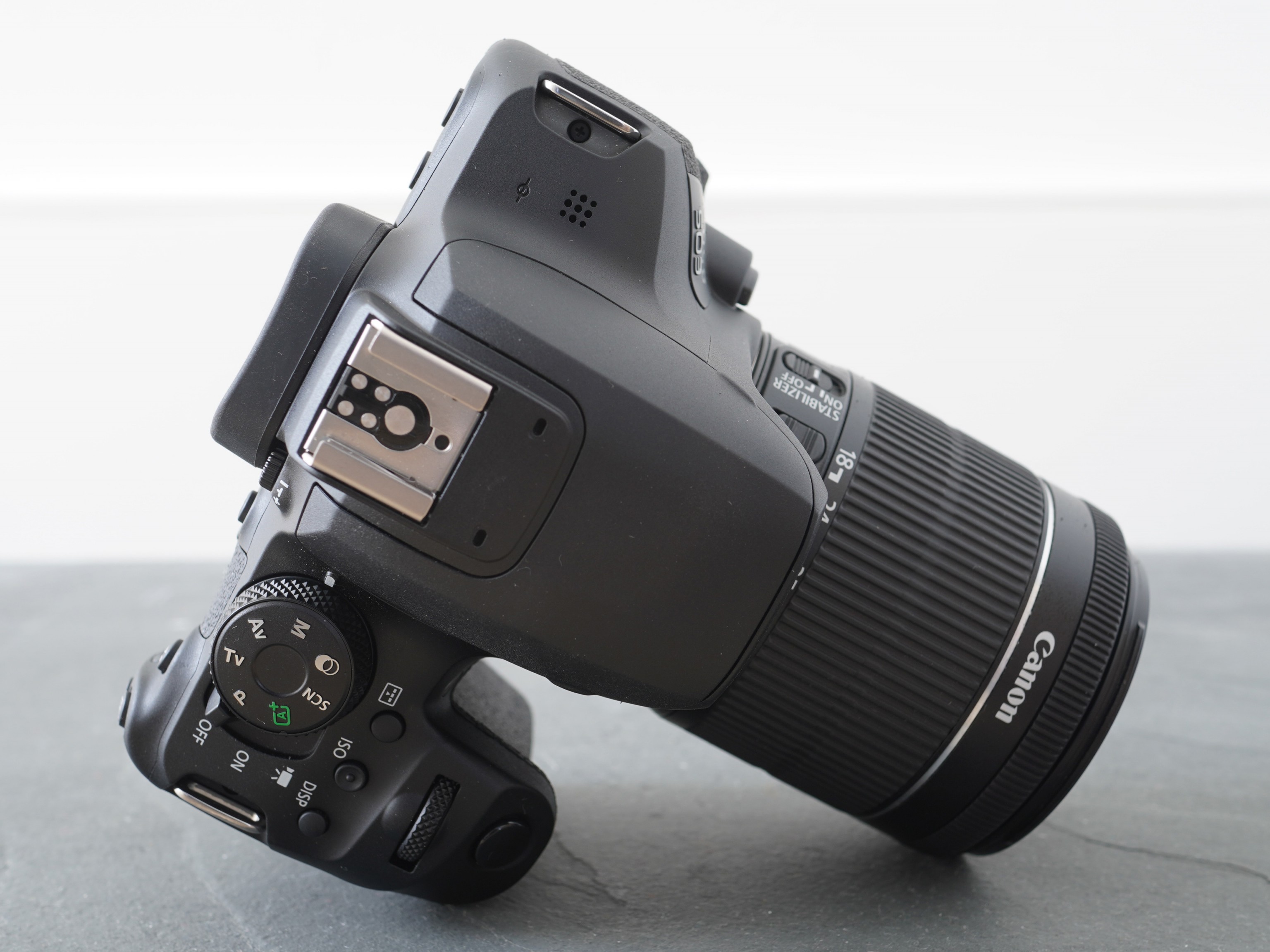
Depending where you hot, the 850D costs roughly deuce thirds the price of the Eos 90D, merely is remarkably faithful to the EOS M6 II body making IT a tempting alternative. I'm also going to throw off the Eos M50 into the mix, a compact mirrorless camera that like the 850D also has a 24 Megapixel sensor and in full-articulated screen, but comes with a wider 15-45mm kit zoom. Meanwhile if you're aft Canyon's cheapest exchangeable lens television camera with an APSC sensor and view finder at the time of testing, that'll atomic number 4 the EOS 2000D or Rebel T7.

Above: Here's the 850D on the left and the 90D on the right, where it's clear the 850D is the smaller camera, but not by a huge gross profit margin. It's a trivial shorter and a tad dilutant, merely the biggest size difference is the width which is about one centimeter fewer. Weight-wise there's a more evident difference, with the 850D consistency nonnegative shelling weighing-in at 515g making it almost 200g ignitor than the 90D.

Above: In your hands, the 90D definitely feels a slight heftier, only in a more substantial, positive style. The deeper clutches of the 90D with big grippier surfaces to wrap your hands about felt better to Maine personally, while the slightly bigger size didn't make much difference in my suitcase. I certainly see the appeal of littler cameras, merely if you want a probative difference, I'd suggest a mirrorless model like the Eos M50.
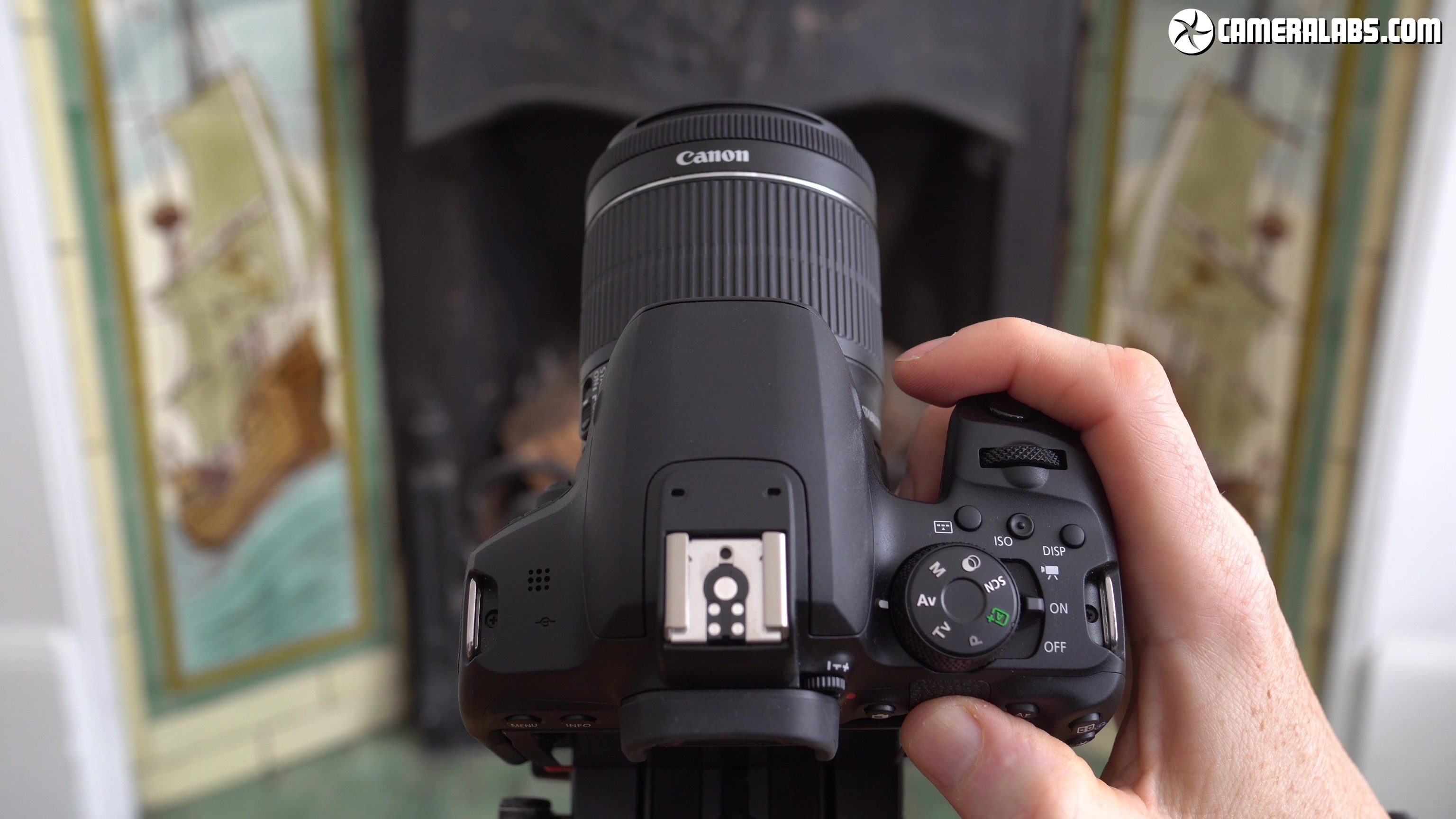
Above: In terms of controls, the 850D's unlockable mood dial is positioned on the right side with a low-set switch that powers it happening for stills, then switches it to movies. There's a finger dial away the clicky shutter release and rounded the noncurrent a small thumb wheel which doubles as a rocker. Meanwhile three buttons on the upper surface are devoted to adjusting the AF area, ISO and presentation mode.

Above: For comparability, here's the 90D's controls start with its mode telephone dial on the upper left side surrounded by a chunky power switch. Unlike the 850D, the mode dial is locked to prevent extrinsic turns and you motivation to push down on a central button to free it. The position of the mode dial on the left frees-up the uncastrated right surface for an LCD status display which shows a wealth of shot entropy at a glint. Like the 850D in that respect's a front finger dial, but the rear hitch wheel is larger with more positive feedback and a cradle within. Unlike the 850D, the 90D also sports an AF joystick as well as a insure by the viewfinder that switches the tv camera between stills and movies. The shutter release is also a balmy-touch model unlike the clicky 850D button, spell thither's like a sho quaternion buttons dedicated to adjusting the autofocus and drive modes, ISO and metering. As ever it's down to personal preference, but I much desirable the 90D's controls o'er the 850D.

Above: Encircle the in reply, the 850D is equipped with a side-hinged amply-articulated blind that's perfect for selfies, vlogging and filming pieces to camera, as fit as twisting for soothing shooting at any angle whether in the landscape or portrait orientation. Side-hinged screens may require cardinal actions versus one for a tilting mechanism, As well as moving away from the optical axis and sometimes obstructing ports too, just I still prefer their tractableness. The 90D shares the same flexibility but with a somewhat large 3.2in dialog box versus 3in along the 850D, although both have the same 1040k dot resolution.
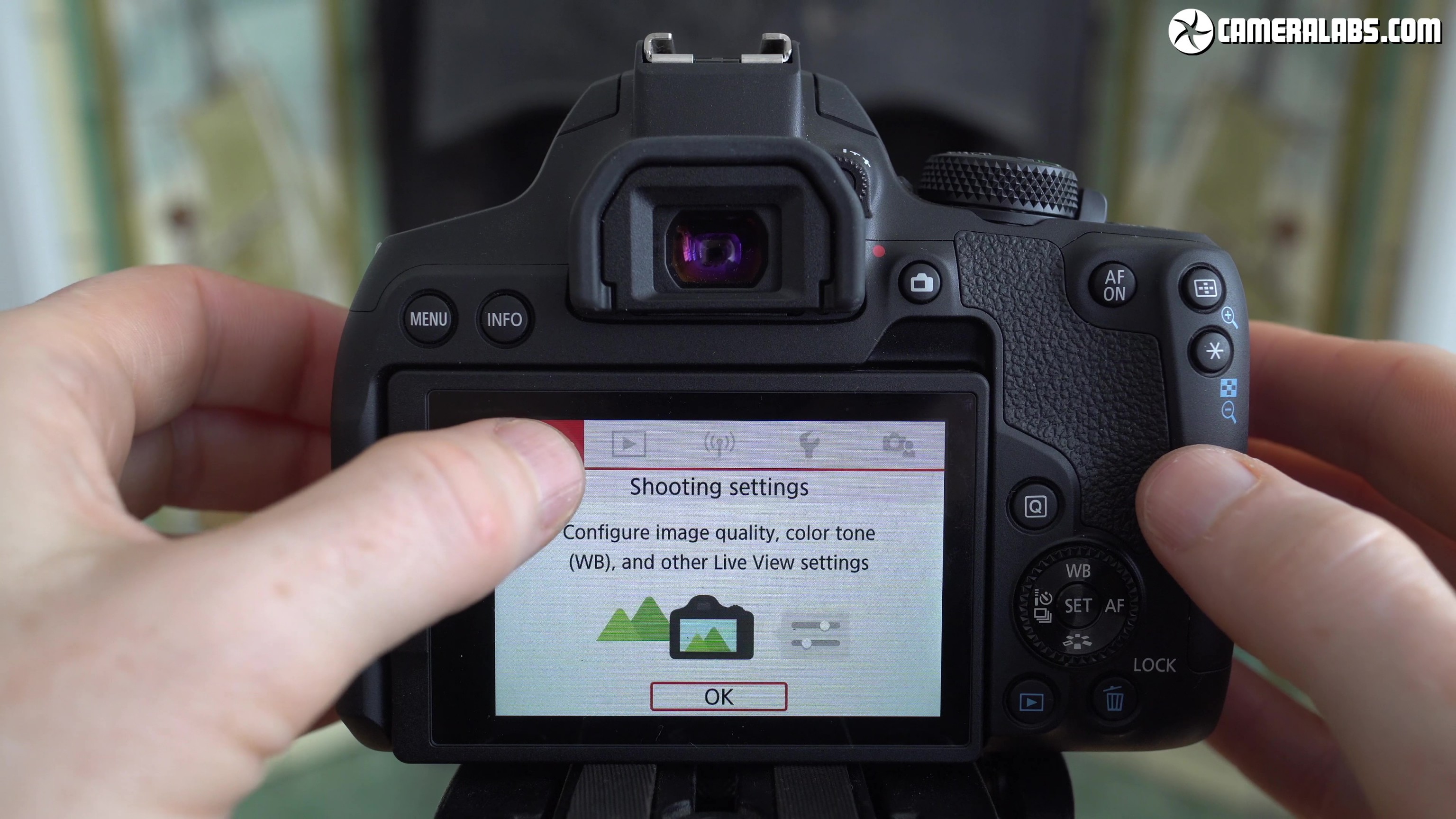
Above: Canon's mite user interface is one of the best around. You can fully navigate the Quick menus by touch if desired, arsenic well as tapping to reposition the focussing area. The of import tabbed menu system besides works by bear on, and is surprisingly simplified to voyage and select this manner, even up though you can use physical buttons if you prefer. Meanwhile in playback you can swipe through images before pinching to zoom, effortful around and reduplicate-tapping to return again. Information technology all feels very intuitive and religious music.

Above: As a DSLR, the 850D is equipped with a handed-down optical view finder for composition, indoors which you'll see the viewfinder autofocus system and the lozenge area it occupies. Like other members of the same series, Canon's stuck with a penta-mirror organisation which on the 850D delivers a fairly small magnification of 0.82x and 95% coverage. The 90D's penta-optical prism viewfinder delivers a observably larger view with 0.95x magnification and 100% coverage too for more accurate framing, but unlike the electronic viewfinders of mirrorless cameras, you can't use an optical view finder for playback, adjusting menus or doing anything with video. Again it boils down to personal preference, but I prefer natural philosophy composition, although when tracking erratic seagulls I did enjoy the absolute absence of lag on these optical viewfinders.

Above: The 850D is powered past the LP-E17 battery that claims roughly 800 shots with the optical viewfinder or 300 in live in view, compared to the slightly large LP-E6N ingroup in the 90D which claims 1300 shots through and through the viewfinder. If you're able to fool mostly with the optical viewfinder, both leave outlive a mirrorless photographic camera with 100% electronic composition, although in terms of video life, I still managed two and a half hours of 1080 25p happening a single change on the 850D or just over quaternion hours happening the 90D, albeit split into one-half hour clips. Annoyingly neither camera can be charged internally over USB, thusly you'll motivation to use the supplied AC adapter.

Above: Two rubber flaps hide the 850D's ports. Behind one is a simple wire release port alongside a microphone input, the last mentioned positioned crushed to considerately minimise obstructions with the screen flexible joint when filming. Behind the second flap is a Micro USB port which dismiss be used for data, removed control operating room webcam streaming, but again non charging, while below IT is a Mini HDMI which can deliver a complete output. The 90D shares the same USB and HDMI connectivity, just adds a headphone jack, fashioning it a better choice for to a greater extent serious videographers. As removed as radiocommunication is implicated, both offer Wifi with Bluetooth for easy telephone set connectivity.
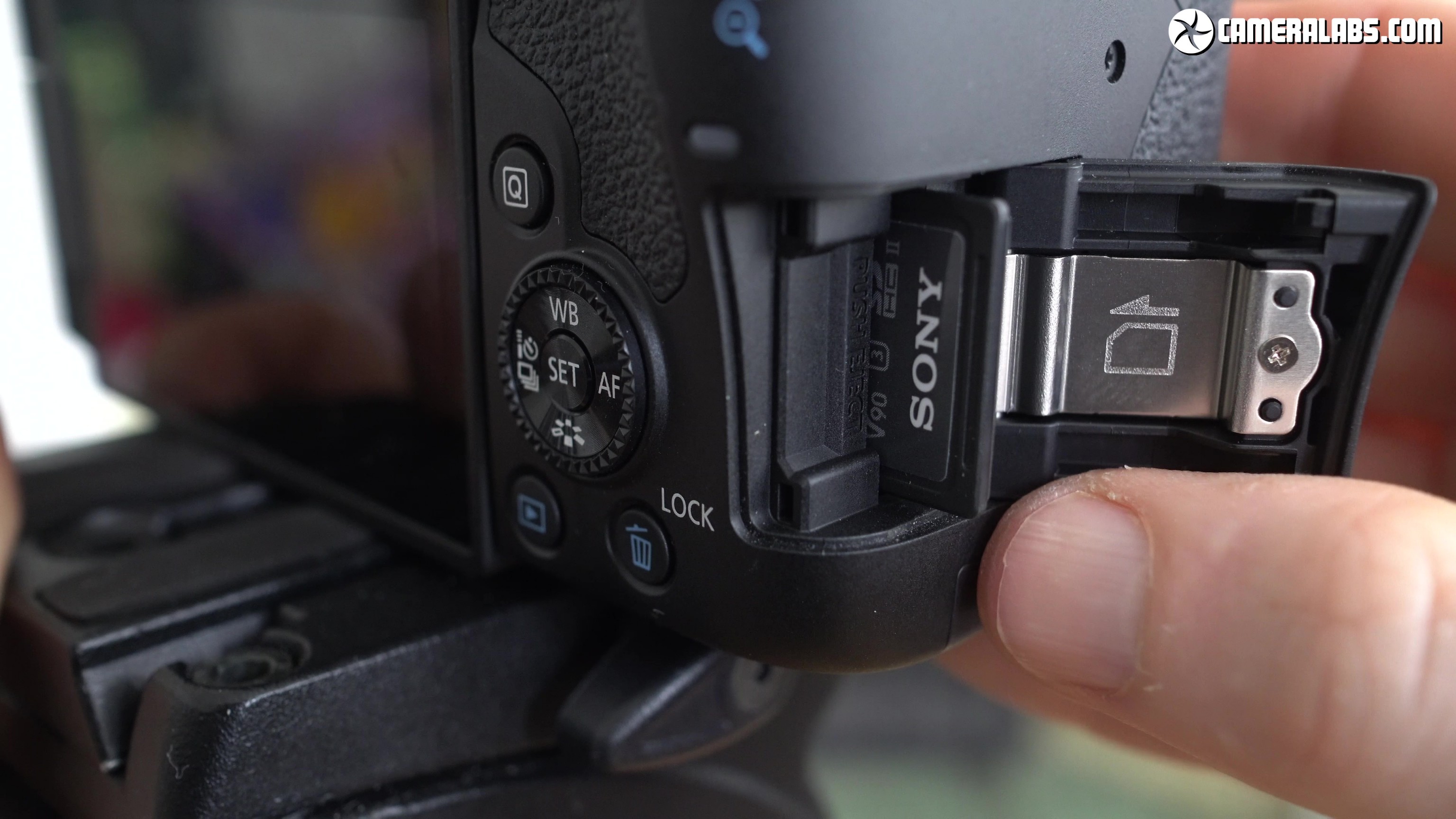
Higher up: In terms of memory the 850D is equipped with a single SD card slot – the similar American Samoa the 90D, although it runs slower, unable to work the additive speed of UHS-II card game. A small bonus manoeuver to the 90D so, although that camera really should accept had match SD slots.
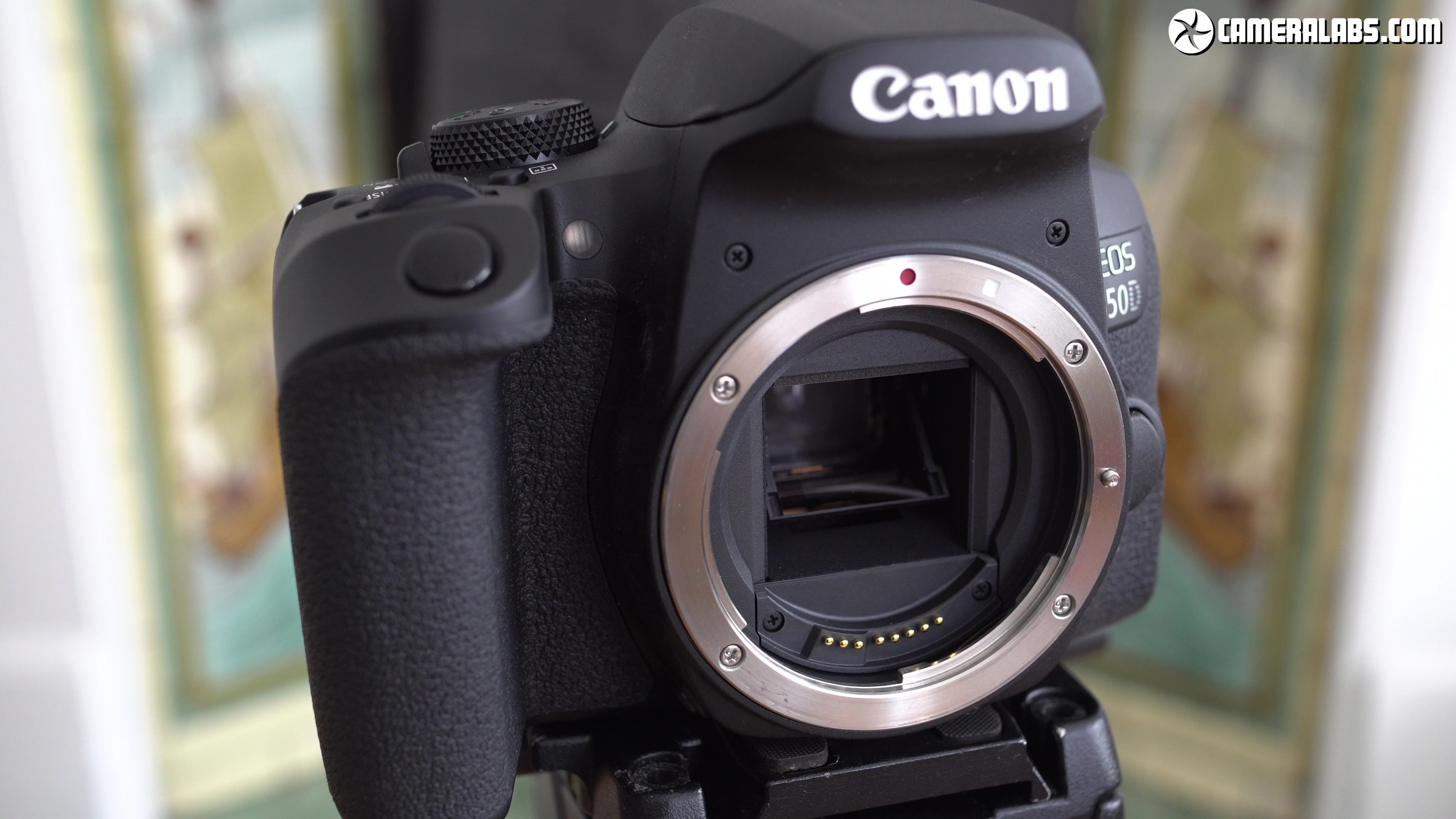
Above: As a Canon DSLR, the 850D is of course equipped with an EF crystalline lens mount, and as an APSC poser, it's also compatible with EF-S lenses; anything you mount bequeath have the field of view reduced by 1.6 times. It's easy to skip-over the lens mount on Canon DSLRs, but it provides access to one of the broadest range of lenses, not to mention a thriving third-company and sec paw market. If you're wondering what lens to buy next, how around the EF 50mm f1.8 STM for exploring portraits and shallow depth-of-field effects, or perchance the EF-S 10-18mm STM for ultra-wide landscapes, architecture and vlogging, and neither poser volition break the bank.

Supra: Behind the DSLR mirror is a 24 Megapixel APSC sensor which once more reduces the field-of-view of all lenses by 1.6 times, so the 18-55mm kit out zoom becomes equivalent to 29-88mm. Like all Canyon DSLRs to date, the sensor is not stable within the body. IT delivers images with 6000×4000 pixels, ransomed in JPEG, Unjust surgery both, and the turnout is familiar from many earlier Canon bodies that shared the same sensor, including the Eos m50. Merely after sticking with 24 Megapixels for its APSC sensors for some prison term, Canon introduced a new 32.5 Megapixel detector in 2019 which made its debut on the 90D and M6 II; this capture images with 6960×4640 pixels.

Above: To find out how they comparison, I guessing the same outside conniption with both the 850D and 90D moments apart and fitted with the same EF-S 18-135mm kit zoom set to 50mm f8. Hera's the 850D edition, and zooming-in reveals enough of fine particular. But how much more detail can you expect from the 90D?

Above: Here's the 850D connected the socialist and the 90D on the right, some JPEGs out of camera and armoured to the aforementioned height where the most striking thing is how interchangeable their output looks, give or conduct a little difference in contrast imputable lighting. The 90D's sensor may sport or s 15% more pixels in the horizontal and vertical axes, but fit them with the same kit zoom and you're unlikely to acknowledge any actual difference, and even with higher timber optics, the benefit of the 90D and M6 II over 24 Megapixel models is subtle to read the least.

Above: How or so noise levels throughout the sensitivity range? To find extinct, I shot this still-animation with some cameras, once more moments apart with the same EF-S 18-135mm kit zoom, this time at 35mm f8 and at all sensitivities.

Above: Now let's take a closer look at the results from some cameras with the 850D on the left and the 90D on the right, starting at 100 ISO and increasing to 25600 ISO; the full sequence is available in my video review above. These are JPEGs tabu of camera as support for RAW from Adobe was not available at the time of testing. There's small differences in their elan, only again the overwhelming outcome is how similar the deuce cameras take care when their images are presented at the same size, and while RAW may unlock just about detail, IT's likely to keep them on a rough level playing field. So in terms of paradigm quality, the 90D and M6 II may technically out-resolve 24 Megapixel models on resolution charts with decently lenses, but in real-animation situations you're improbable to placard much if any difference.

Above: Both the 850D and 90D share the same viewfinder AF system, a 45-guide all cross-type set out that, like most DSLRs, occupies a lozenge-shaped area concentrated in the middle of the fles. The 850D lets you electric switch between a one AF area, zoned operating room the entire array, to which the 90D adds a smaller smear-area option, but the number and arrangement of points stiff the aforementioned.

Above: Interestingly both cameras offer basic face detection with their viewfinder AF systems, nonvoluntary aside their fair high resolution metering sensors. This is enabled away default from the custom menus and works fairly fortunate, at least inside the portion of the frame tiled by the AF array.

Above: Switching to live look at with composition using the screen only unlocks far more literate grimace and eye detection that whole shebang crosswise most of the frame. It's impelled by Canon's Dual Pixel AF which even in the mark I version Here provides confident results. I'm using information technology Here with the EF 50mm f1.8 STM lens for a more challenging test. Like the 90D, the all but sophisticated autofocus modes on the 850D are in Live View, but as DSLRs this is non available when composing with the viewfinder. For me this is one of the major benefits of mirrorless cameras which allow their best AF performance whether you're using the screen or viewfinder.

Above: In terms of bursts, the 850D can fire-off long sequences of JPEGs or RAW files at equal to 7fps with the viewfinder with single or continuous Servo autofocus. Here's a skeleton from a outburst with the 850D and EF-S 18-135mm, set off to 135mm f5.6 and victimization the view finder AF system. Checking the timestamps of the images confirms the 850D can buoy maintain 7fps with continuous Servo AF, at to the lowest degree when shooting with the optical view finder. While I in person prefer electronic composition overall, I did enjoy the complete absence of lag when following the seagulls with an receptor viewfinder. That said, the 90D is the better natural process camera, non only shooting faster at 10fps, but besides offering a 1/8000 shutter speed that's twice A agile as the 1/4000 maximum of the 850D. And for times when you need to be discreet, the 90D as wel offers a silent electronic shutter option in live view, although in my tests it proved same impressible to skewing from rolling shutter.

Supra: Moving onto video, the 850D terminate picture uncropped 1080 at 25 or 50p when rigid to PAL, or at 24, 30 or 60p when put off to NTSC; good to see Canon remembering to include 24p connected a new camera without facing the wrath of youtubers. 4k is too available at 24 or 25p when set to NTSC or Crony respectively, but some with a substantial crop of around 1.5 times. 4k is too express to less cocksure contrast autofocus, leaving the superior Duple Pixel autofocus to 1080 video only. Sadly there's also no frame rates higher than 60p on the 850D, so no chance for slow motion beyond a 2x slow-down
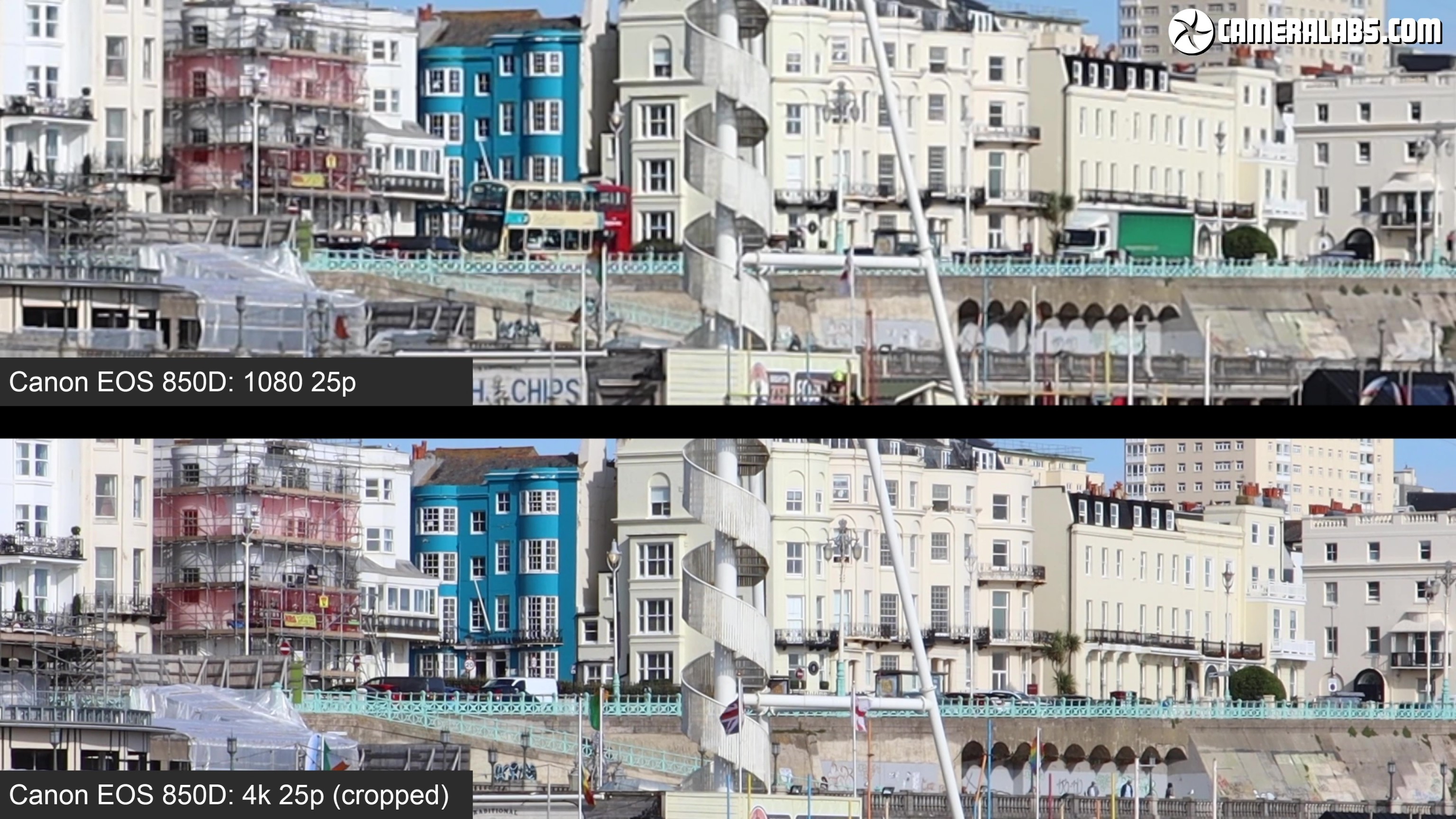
Above: Ok now for some comparisons, starting with the 850D in 1080 at 25p and forgive ME for the slightly shaky footage as the pier was being battered by the deep-sea. This was filmed at 50mm. Now for the same view with the 850D in 4k at 25p without adjusting the field to illustrate the crop when motion-picture photography in this mode. But is it resolution finer detail? To find out, here's the 1080 clip in the elevation half and 4k trot in the bottom half, with the zoom adjusted happening the latter to match the field of view. You'll need a gamey res display to see the difference, but the 4k is definitely transcription greater detail, albeit with the caveats mentioned.

Above: Is the 90D any better? Hither IT is filming 1080 at 25p at 50mm, and today filming 4k 25p again at 50mm. Yes, the 90D offers unplanted 4k and in a advance bonus over the 850D also supports dual pel autofocus, making information technology a good deal more practical. For comparison, here's the 850D's cropped 4k in the bottom half, while in the top half is the 90D's uncropped 4k, and you may be popeyed to learn the 850D may actually be delivering better detail. This is due to the way each camera scales the detector information to deliver a 4k frame and if you prefer, the 90D alternatively offers a cropped 4k mode.

Above: So here's the 850D's planted 4k in the bottom half, but now with the 90D's cropped 4k in the top off incomplete, both scaled to birth the same area of view. The impact of video processing nates be confusing, but with the choice of cropped surgery uncropped 4k, dual pixel AF in 1080 and 4k, as well as slowmo 1080 that's absent along the 850D solely, the 90D is the more capable television camera for video.
But while the 850D may crepuscule behind the features of the 90D, it's still a capable camera for telecasting, specially in 1080. Two-fold-pixel autofocus works OK in 1080p, using the touch CRT screen to confidently pull-sharpen. 4k terminate also work well for simple rive-pulls despite victimization a demarcation-based AF system. Moving targets are where dual pixel really shows a noticeable lead though. Thusly alike Canyon's other 24 Megapixel models to date, 4k video along the 850D isn't particularly practical and unless you really understand its limitations and how to work some them, information technology's best to toy with the 850D as a 1080 tv camera only. If you want more usable 4k from Canon, you'll need the 90D OR M6 II, or view a Sony like the A6400.
If you're into posting video on social networks, you will however appreciate the ability to film in the vertical format and have it continue this shape, and thanks to easy wireless and a decent app, it's straightforward to buzz off them onto your phone for sharing.
Check prices on the Canon EOS 850D / Rebel T8i at B&adenylic acid;H, Amazon, Adorama or WEX! Alternatively get yourself a copy of my In Camera book or treat me to a chocolate! Thanks!Pages: 1 2 3
Canon EOS 850D Rebel T8i review
Source: https://www.cameralabs.com/canon-eos-850d-rebel-t8i-review/

Posting Komentar untuk "Canon EOS 850D Rebel T8i review"